
Editorial Fisacorp
Landfill leachate, the dark liquid that seeps out of waste piled up in sanitary landfills, is usually remembered only as a problem: it is salty, loaded with ammonia and requires expensive treatment before it can return to the environment. Research from the State University of Campinas (Unicamp), reported by Agência FAPESP on November 10, 2026, shows another angle. From this effluent, the team recovered two minerals with agricultural value, struvite and carnallite, and tested the result as a fertilizer in tropical soil.
The innovation
The work, led by researcher Jerusa Schneider of Unicamp's Institute of Geosciences, with professor Adriano Luiz Tonetti and colleagues, was published in the scientific journal Soil & Environmental Health. The leachate came from a landfill in Campinas, São Paulo state. Through chemical precipitation, the researchers formed struvite, a slow-release source of nitrogen, phosphorus and magnesium, and, with a second combination of reagents, struvite with carnallite, a mineral rich in potassium and magnesium. According to Agência FAPESP, obtaining carnallite from urban waste in this way is unprecedented; it traditionally comes from deep mining.
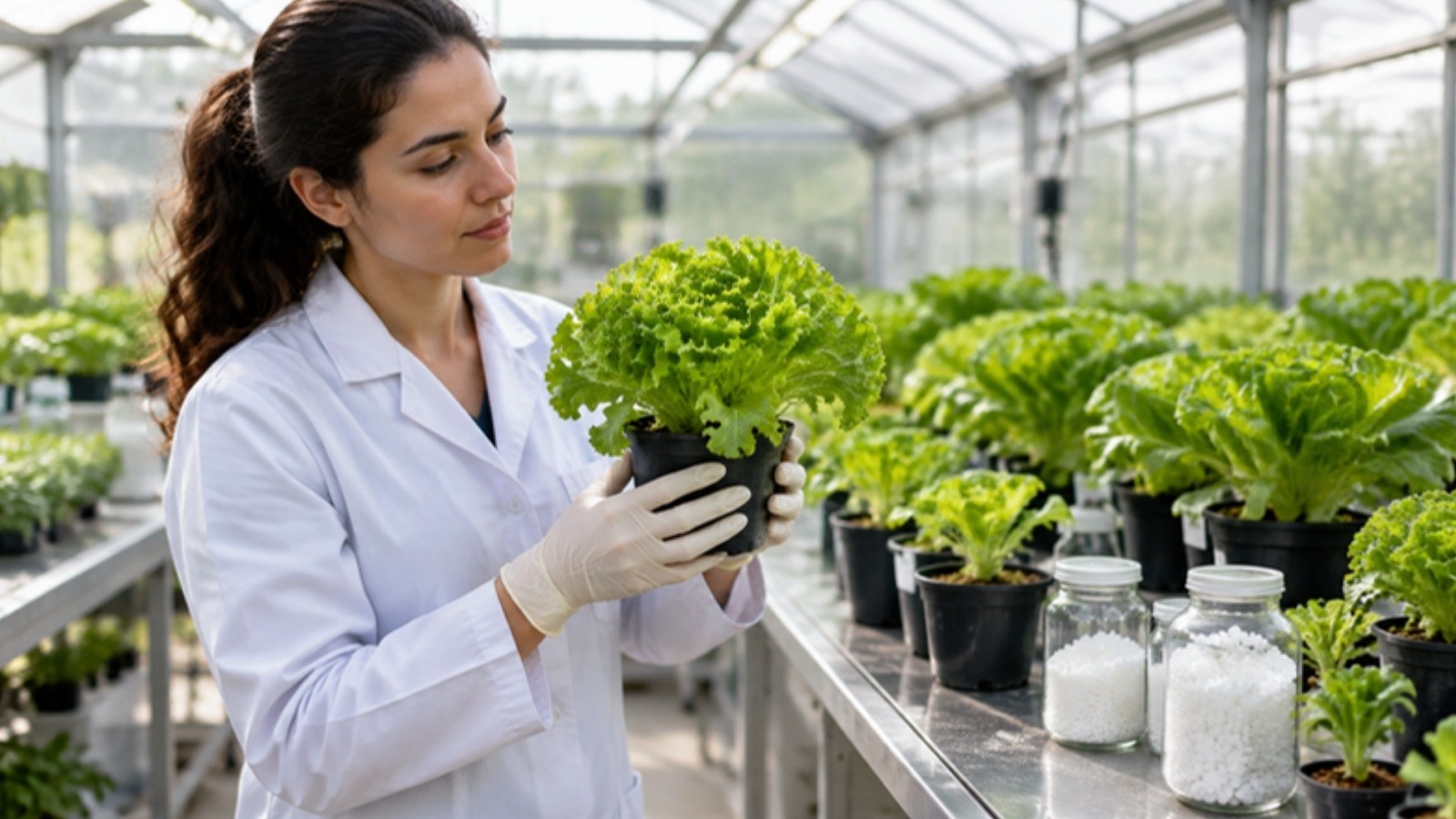
To assess agronomic performance, the team grew lettuce in a greenhouse, in a tropical soil that retains a great deal of phosphorus, and compared the recovered minerals with a commercial NPK fertilizer.
The positive impact, in numbers
- Productivity: the struvite treatment that supplied twice the recommended phosphorus dose produced 105% more shoot dry mass in the lettuce than the commercial NPK, according to the paper. The result refers to that experimental condition, not to a comparison between equal phosphorus doses.
- Potassium: the struvite-carnallite mix, applied to supply twice the recommended phosphorus dose, resulted in the highest leaf potassium levels among the treatments tested.
- Safety: cadmium and lead levels in plant tissue stayed within regulatory limits, and the authors report that the recovered minerals contain less of these metals than conventional fertilizers.
- Cleaner effluent: the process removes nitrogen, the main pollutant in leachate; the stage assessing the reuse of the treated water for irrigation is still under scientific review.
Why it matters
According to Agência FAPESP, Brazil imports 96% of the potassium it uses as fertilizer. Turning an urban liability into an input for farming brings together two agendas that usually run separately: waste management in cities and input security in agribusiness. For Schneider, “it is a sustainable alternative for obtaining potassium without the environmental cost of mining.”
The limits also need to be considered. The trial was carried out in pots, with a short-cycle crop, and Tonetti himself acknowledges that the process is still expensive. He suggests pilot projects with landfills, batch treatment of leachate and public incentives to make scale viable. A new three-year project funded by FAPESP will go deeper into the use of urban solid waste for agricultural and energy purposes.
What trend it signals
The research adds to a global movement in nutrient recovery that sees sewage, leachate and organic waste as “urban mines” of phosphorus, nitrogen and potassium. It is the circular economy moving beyond talk and into the lab, with agronomic metrics, contaminant testing and direct comparison with the conventional product. The road to industrial scale is usually long, but studies like this help define where investment is worthwhile.
An idea for managers
Try a simple exercise: which waste streams in your operation are treated today only as a disposal cost? Effluents, production leftovers, packaging and even operational data can hide value once someone measures their composition, tests a recovery route and compares it with the conventional alternative. The first step is rarely the big plant; it is usually a well-measured pilot, run in partnership with universities or research centers.
Fisacorp develops technology solutions for fleet management, people management, digital customer service, condominiums and sustainability, and closely follows research like this, which shows how science and management can turn environmental challenges into opportunities.
References
- Agência FAPESP — Research turns landfill leachate into safe fertilizer for agriculture (11/10/2026, in Portuguese)
- Schneider, J. et al. Nutrient recovery from landfill leachate as struvite and carnallite: environmental safety and agronomic performance in tropical soils. Soil & Environmental Health, v. 4, n. 3, 2026
- FAPESP Virtual Library — Grant 2024/15261-9 (in Portuguese)
Sources consulted on November 10, 2026.