
Editorial Fisacorp
With the year-end calendar, many building managers start organizing the meeting that approves the budget, owner contributions and the financial statements. A common question is whether this meeting can be held online, by video call, or with some residents in the common room and others at home. The short answer is yes, since 2022. But the law sets conditions, and a poorly convened meeting may have its decisions challenged.
What the law allows
Law No. 14,309, published in Brazil's Federal Official Gazette (DOU) on March 9, 2022 and in force since then, added article 1,354-A to the Civil Code. It states that the calling, holding and deliberation of any type of meeting may take place electronically. This includes the annual meeting provided for in article 1,350 and extraordinary meetings.
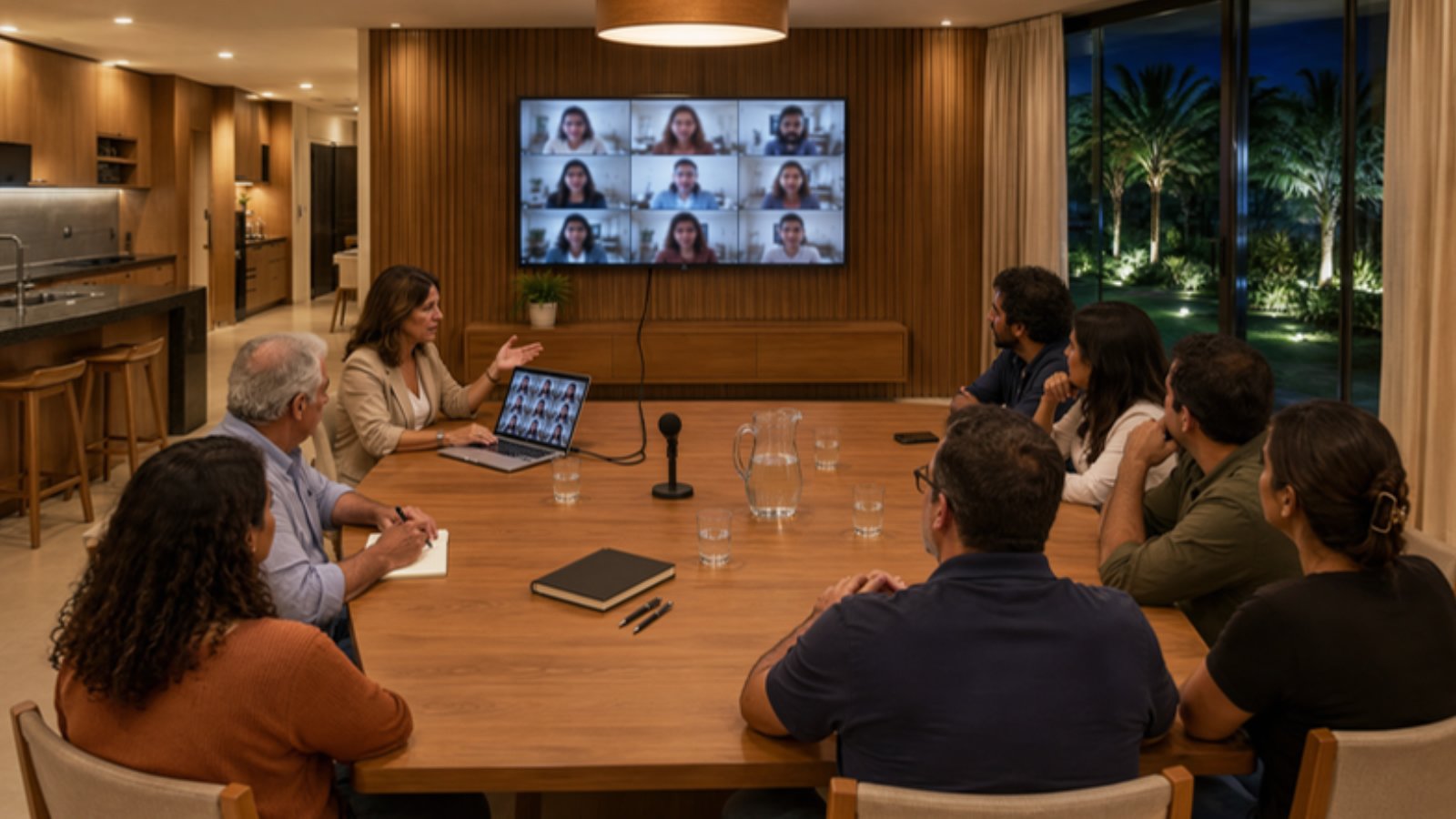
The same rule allows a hybrid format, with some owners physically present and others connected at the same time, in the same meeting.
The two starting conditions
Article 1,354-A only authorizes the electronic format when two conditions are met at the same time:
- The condominium bylaws (convenção) must not prohibit it. If the bylaws forbid electronic meetings, the Civil Code rule does not apply until the bylaws are amended.
- The rights to speak, debate and vote must be preserved. A form to tick "yes" or "no" is not enough: owners must be able to express their views and follow the discussion.
Amending the bylaws requires 2/3 of the owners' votes, under article 1,351 of the Civil Code. That is why it is worth reading the bylaws before setting the date, not afterwards.
What the notice of meeting must include
The law is specific about the notice. It must state that the meeting will be held electronically and include instructions on:
- how to access the meeting;
- how to request the floor and speak;
- how votes will be collected.
The electronic meeting must also follow the opening, operating and closing rules described in the notice itself. The general rule of article 1,354 still applies: the meeting cannot deliberate unless all owners have been called. Agenda documents may be made available on paper or electronically.
Quorum and minutes
The electronic format does not change quorums. On first call, ordinary decisions require a majority of those present representing at least half of the ideal fractions (article 1,352). On second call, a majority of the votes of those present is enough, unless the law or the bylaws require a special quorum (article 1,353).
The minutes also have their own rule: under paragraph 3 of article 1,354-A, they are drawn up, also electronically, only after all votes have been tallied and announced, and only then is the meeting closed.
When the special quorum is not reached
The same law created the permanent session. If the agenda requires a special quorum and it is not reached, a majority of those present may authorize the chair to convert the meeting into a permanent session, provided that, cumulatively:
- the date and time of the continuation, within no more than 60 days, and the pending decisions are stated;
- those present are deemed called and absent units are called as provided in the bylaws;
- partial minutes are drawn up, with the arguments presented, and sent to those absent;
- the deliberation resumes on the set date and time, with the consolidated minutes drawn up afterwards.
Votes cast in the first session remain recorded, and those present at the next session may ask to change their vote until the deliberation ends. The session may be extended several times, but the meeting must be concluded within 90 days of its opening.
Limits and precautions
- Owners' connection failures: the law states that the management cannot be held liable for problems with owners' equipment or internet, or for situations beyond its control. This does not exempt the condominium from offering a working means of access and following the notice.
- Supplementary rules: details such as identification of proxies, speaking time or recording method may be set in the internal regulations, approved by a simple majority of those present at a meeting called for that purpose.
- Specific cases: the law does not specify how to verify the identity of voters or which platform to use. Older bylaws, sensitive agenda items and high quorums deserve review by a specialized lawyer.
Step by step for the next meeting
- Read the bylaws and internal regulations and confirm there is no prohibition on the electronic format.
- Choose the format: fully online or hybrid.
- Choose a tool that allows speaking, debate and voting, and test access beforehand.
- Draft the notice stating the electronic means and the instructions for access, participation and voting.
- Send the notice to all owners through the channels set out in the bylaws, and keep proof of delivery.
- Make the agenda documents available in advance.
- On the day, record attendance, quorum and votes for each item.
- Draw up the electronic minutes only after tallying and announcing all votes, and share them with everyone.
Where technology helps
Much of the risk of an electronic meeting lies in communication: notices that do not arrive, confusing instructions and residents who do not know where to find the minutes. EnvLiving, Fisacorp's solution for condominiums, brings together resident communication and information organization features to support the management's routine. The validity of the meeting still depends on the bylaws, the notice and compliance with the law.
References
- Law No. 14,309 of March 8, 2022 (Planalto, in Portuguese)
- Civil Code, arts. 1,350 to 1,354-A, consolidated text (Planalto, in Portuguese)
- Virtual meetings and permanent sessions in condominiums (Machado Meyer, in Portuguese)
- Law 14,309/2022 allows virtual meetings and permanent sessions (Dizer o Direito, in Portuguese)
Sources consulted on November 15, 2026.